What Is Radial Shockwave Therapy and How Does It Work?
If you’ve been dealing with a tendon, muscle, or soft-tissue problem that just doesn’t seem to completely go away, you know how frustrating it can be.
You rest it. It feels better.
You start using it again. It comes back.
Or maybe you’ve tried several different approaches and made progress—but eventually hit a wall.
That’s one of the reasons we’ve added Radial Shockwave Therapy at Ozark Functional Wellness.
First, it doesn’t actually “shock” you
The name can be a little misleading.
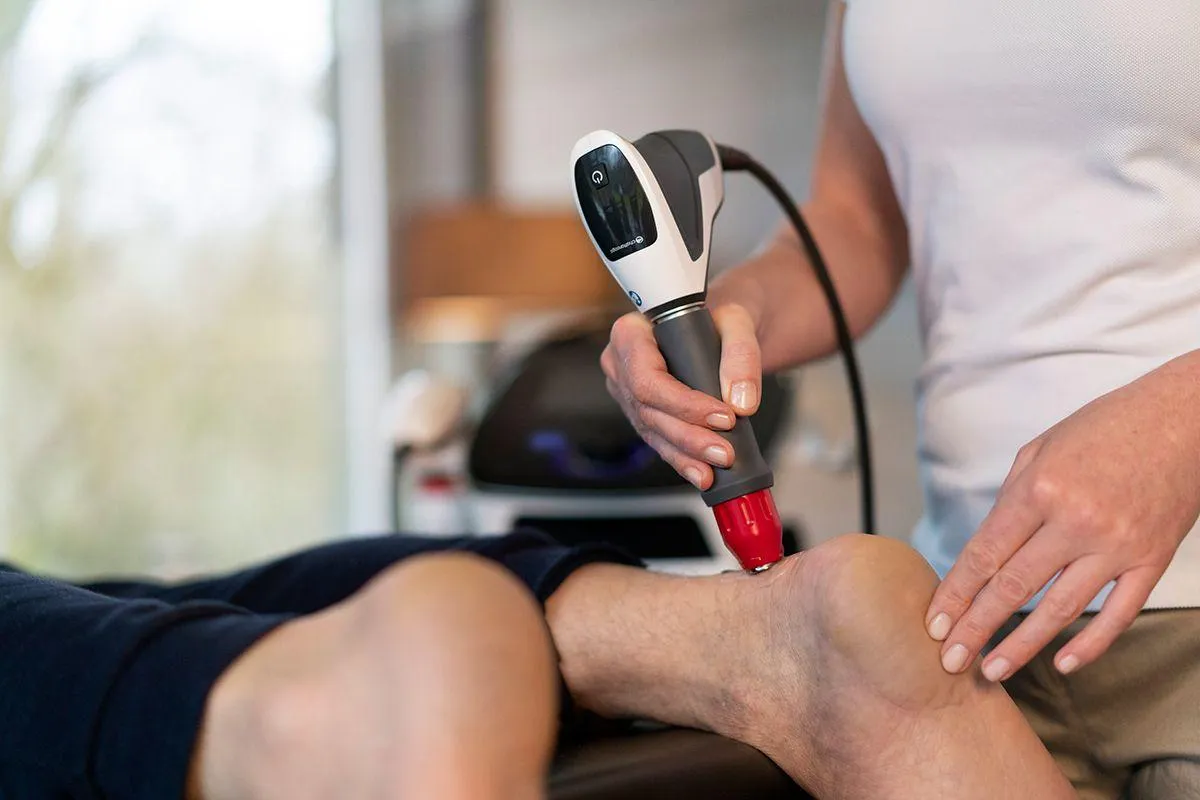
Radial shockwave therapy doesn’t use an electrical shock. Instead, a handheld applicator generates rapid acoustic pressure waves that transmit mechanical energy into the targeted tissue.
That mechanical stimulation can influence circulation, tissue metabolism, pain signaling, and biological processes involved in tissue repair.
In simple terms, we’re using mechanical energy to encourage a stubborn area to respond differently.
Why use shockwave for chronic problems?
When you injure yourself, the body normally goes through a coordinated healing process.
But sometimes an area doesn’t progress as expected. This is especially common with certain chronic tendon problems.
At that point, simply resting the area—or repeatedly treating the symptoms—may not be enough.
Radial shockwave gives us another way to stimulate the tissue and potentially encourage a new healing response.
That's what makes this therapy particularly interesting to me.
It isn't simply about temporarily making an area feel better. The goal is to influence the environment of the tissue itself while we also address the mechanical factors that may be contributing to the problem.
What kinds of problems can radial shockwave be used for?
Shockwave therapy has been studied most extensively for musculoskeletal problems involving tendons and their attachment sites.
Depending on the individual, it may be considered for problems such as:
Plantar heel pain / plantar fasciitis
Achilles tendinopathy
Patellar tendinopathy
Tennis elbow
Golfer’s elbow
Certain chronic shoulder tendon problems
Calcific shoulder tendinopathy
Other persistent areas of muscle and tendon pain
That doesn't mean every painful area should be treated with shockwave.
The diagnosis matters.
Before using it, we want to understand what tissue we're treating, why it may be hurting, and whether shockwave is actually an appropriate choice.
What does a treatment feel like?
During treatment, the applicator is placed directly over the targeted area and delivers a series of rapid pressure pulses.
You'll definitely know something is happening.
Some areas may be mildly uncomfortable—especially when we find the tissue that is already irritated—but the intensity can be adjusted based on your tolerance and the area being treated.
The actual shockwave portion of a visit is typically relatively quick.
Is one treatment enough?
Usually, shockwave isn't viewed as a one-and-done treatment.
Depending on the condition and how long it has been present, a series of treatments may be recommended. Just as importantly, shockwave may be combined with other approaches when appropriate.
That could include chiropractic care, mobility work, rehabilitation, changes in loading or activity, or other treatments aimed at addressing why the tissue became irritated in the first place.
I don't want to simply chase the painful spot.
I want to understand the problem we're trying to solve.
Another tool—not a magic wand
This may be the most important thing to understand about shockwave therapy.
It isn't magic, and it isn't appropriate for everyone.
But the research behind shockwave for several chronic musculoskeletal conditions is encouraging, and it gives us another non-surgical option to consider when dealing with stubborn problems.
That's why I decided to bring it into the office.
Sometimes what we're already doing works beautifully.
Sometimes we need another tool.
And when you're dealing with something that just won't go away, radial shockwave therapy may give us another way to approach it.
Interested in Radial Shockwave Therapy?
If you're curious whether shockwave might be appropriate for something you've been dealing with, ask me about it during your next visit or contact Ozark Functional Wellness.
We'll determine whether you're a good candidate and whether it makes sense for your particular problem.
Ozark Functional Wellness
Nixa, Missouri

